AI Hallucinations in Georgia Courts

Get Help from Diwan Law, LLC

Have you been sued by a credit card company, debt buyer, or collection agency in Georgia? Are you thinking about using AI to help you respond to the lawsuit?

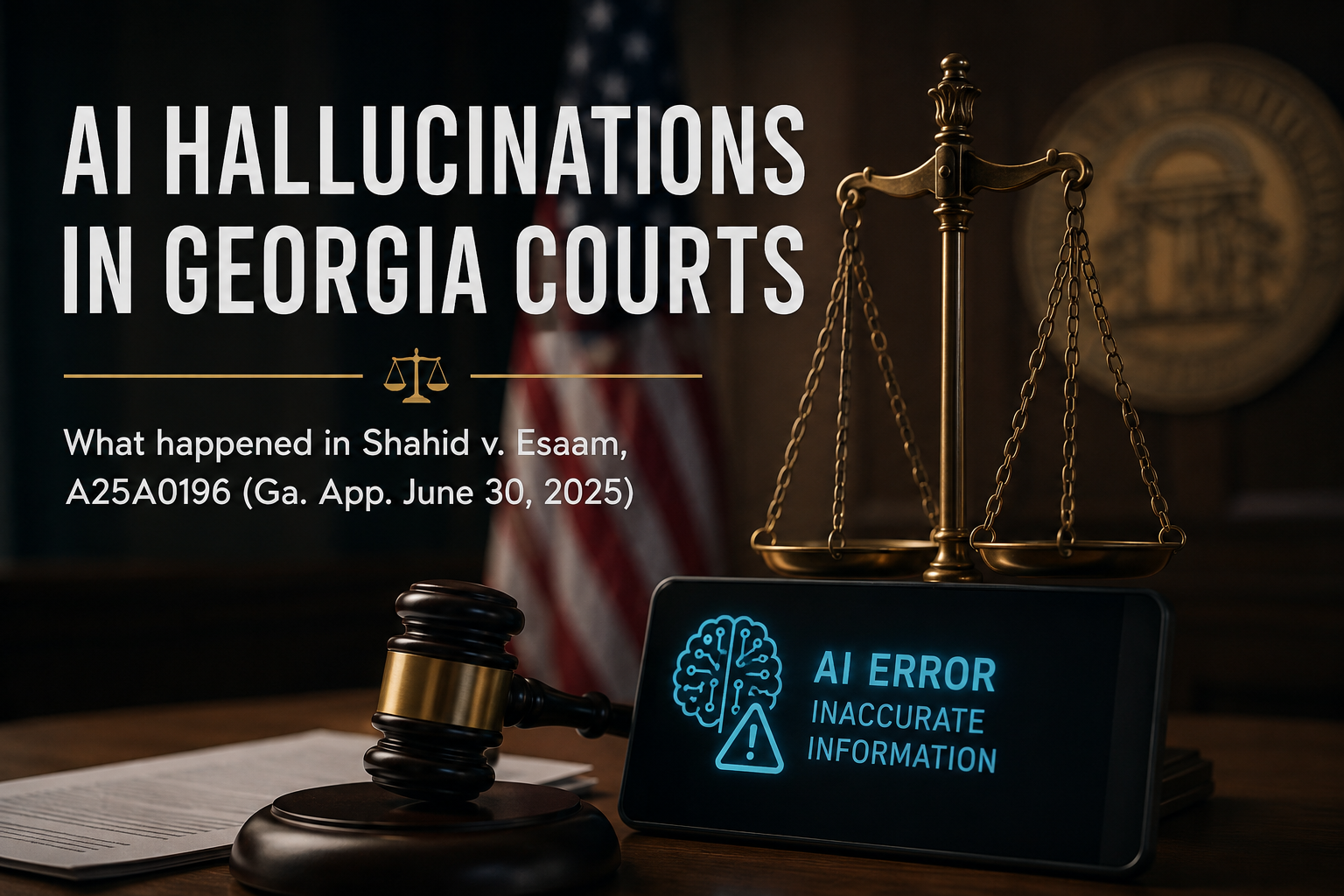
If so, you need to understand what happened in Shahid v. Esaam, A25A0196 (Ga. App. June 30, 2025) [hereinafter "Shahid"]. Contact Diwan Law at 404-635-6883 for a free case evaluation.

What happened in Shahid v. Esaam?

Shahid was a divorce case. The wife sought to reopen the case, arguing that her husband had not exercised sufficient diligence to locate her before using service by publication.

On appeal, the wife pointed out something extraordinary. The trial court's order relied on two fictitious cases.

The Court of Appeals then discovered more problems with the husband's appellate brief. The brief contained 15 case citations, 11 of which were either hallucinated or unrelated to the propositions for which they were cited.

The Court stated that the irregularities suggested the filings may have been drafted using generative AI.


What did the Court do?

The Georgia Court of Appeals imposed a $2,500.00 frivolous-motion penalty against the attorney. The Court also vacated the trial court's order and sent the case back for a new hearing.

The Court emphasized that AI can assist lawyers, but attorneys remain responsible for ensuring that what they file with a court is accurate. Citing the federal Mata v. Avianca decision, the Court explained that there is nothing inherently improper about using a reliable AI tool for assistance.

But, lawyers have a gatekeeping responsibility to verify the accuracy of their filings.

What does this have to do with debt collection?

Shahid was a divorce case. So, why does it matter if you are being sued by a junk debt buyer or credit card company?

Because the same principle applies. Whether you are a lawyer or a consumer representing yourself, the arguments you make in court must be based on real law and real evidence.

Unfortunately, AI programs and online forms cannot replace careful review of the specific lawsuit, the evidence, the court record, and applicable Georgia law. When clients ask me about using AI to draft their own court filings, I tell them it is not worth the risk.

And, there is a major difference between understanding basic terminology and actually defending a lawsuit.

Defenses in a debt collection lawsuit

More specifically, a debt collection defense may involve questions such as:

  • Does the plaintiff actually own the debt and have standing to sue?
  • Can the creditor prove the amount owed?
  • are the account records admissible?
  • Is there sufficient documentation establishing a chain of assignment [i.e. proof that the debt was sold from the original creditor to the debt buyer]?
  • Was the lawsuit filed within the statute of limitations;
  • Was the defendant properly served?
  • factual or legal defenses that should be raised; and
  • Is settlement preferable to litigation under the circumstances.

The right defense depends on the facts and evidence in your specific case.


WHY HIRE A DEBT DEFENSE LAWYER?

A lawsuit is not a collection letter. Once a creditor or junk debt buyer files a case, court rules, deadlines, and evidence matter.

The worst thing you can do is nothing.

If you do not respond to the lawsuit, the debt collector will get a default judgment against you. Armed with the default judgment, the debt collection company can garnish your wages and bank accounts.

Diwan Law will assert all viable defenses you may have, file the appropriate motions, and negotiate with the creditor. We have the knowledge and experience to defend you in every aspect of your case.

We do not generate a form response and send you on your way. No matter where you are in the collection process, you deserve to know your rights and what to expect.

Give us a call at 404.635.6883.

Conclusion

If a junk debt buyer, credit card company, bank, or collection agency has sued you in Georgia, do not ignore the lawsuit. And, do not rely on AI-generated legal research to defend yourself.

Contact Diwan Law, the debt defense lawyer, today at (404) 635-6883 to schedule your free case evaluation.

About Diwan Law

Diwan Law is passionate about getting our clients the best result possible.

Diwan Law handles debt collection actions against consumers in the Magistrate, State, and Superior Courts of Georgia.

Diwan Law represents clients facing:

  • Debt buyer debt collection lawsuits (i.e. Midland Funding, Portfolio Recovery Associates, Asset Acceptance, Cavalry Portfolio Services, Unifund, etc.);
  • Original creditor debt collection lawsuits (i.e. American Express, Citibank, Suntrust, etc.);
  • Debt collection lawsuits arising from credit cards, automobile repossession deficiencies, apartment leases, and other contract-related matters;
  • Dormant judgment revival; and
  • Garnishment actions on bank accounts or wages.

Diwan Law Handles Cases in:

Gwinnett County Magistrate Court; Dekalb County Magistrate Court; Cobb County Magistrate Court; Fulton County Magistrate Court; Henry County Magistrate Court; and most other magistrate courts in Georgia.

Tags: Attorney, consumer rights, debt collection defense, AI hallucinations, Georgia courts, debt buyer lawsuit, garnishment, fdcpa

* The information presented in this article does not constitute legal advice. All information, content, and materials presented on this website are for general informational purposes only. If your business is sued, we encourage you to contact Diwan Law before taking any action.