A letter arrives, or a phone call, or a summons. The name on it is Midland Credit Management, and the debt it describes started with someone else entirely.
That raises a fair question. Who is this company, and what gives it the right to collect on an account you opened with a different lender?
The answer matters most if a Midland Funding lawsuit has landed in your mailbox in Georgia. Claiming you owe money is one thing. Having the legal right to sue you for it is another.
Who Is Midland Credit Management, and Who Does It Collect For?
Midland Credit Management, often shortened to MCM, is a debt collection company owned by Encore Capital Group. It mostly collects delinquent consumer accounts that were bought from banks, credit card companies, and other lenders.
It collects for a group of affiliated companies, including:
- Midland Funding, LLC, which commonly buys and owns delinquent accounts.
- Asset Acceptance, LLC, another affiliate whose accounts MCM handles.
- Affiliates of Atlantic Credit and Finance.
- MRC Receivables Corporation.
- Midland Funding NCC-2 Corporation.
The accounts behind those names can be unpaid credit cards, personal loans, retail financing, or other consumer debts.
Here is the distinction people miss. Midland Credit Management and Midland Funding are separate companies. Midland Funding tends to own the account, while MCM does the collecting. MCM may also service accounts it owns itself.
Why Does Debt Ownership Matter in a Midland Funding Lawsuit?
Picture how many of these accounts travel. You miss several payments on a credit card, the issuer charges the account off, and then it sells the debt. A debt buyer such as Midland Funding may end up holding it, with MCM sending the letters.
If that buyer sues, one question sits underneath everything else. Can the plaintiff prove it owns your specific account?
Debt buyers generally have to show they acquired the legal right to enforce the debt. That can take evidence of how the account moved from the original creditor to the company in the courtroom. A general statement that a company bought thousands of accounts may not prove that yours was one of them.
Georgia's appellate courts have dealt with exactly this problem.
What Did Wirth v. CACH, LLC Decide?
In Wirth v. CACH, LLC, 300 Ga. App. 488 (2009), the Georgia Court of Appeals reversed a judgment for a debt buyer because its evidence did not establish a right to enforce the debt.
The consumer allegedly owed about $2,310 on a credit card account tied to Providian National Bank. CACH, LLC said it had acquired the account and filed suit. To back that up, it submitted an affidavit stating the debt had been assigned to it.
The court found several gaps:
- The affidavit never referenced or attached the written assignments that would show the full chain of ownership.
- Account statements named Washington Mutual, not the original creditor alleged in the lawsuit.
- The bill of sale left out the account schedule that would have identified the consumer's particular account.
- Nothing in the record was competent evidence connecting the companies involved in the transfers.
The Court of Appeals concluded that CACH had not established its entitlement to judgment and reversed the trial court's grant of summary judgment.
What Wirth means for Midland cases
Wirth involved CACH, not Midland Funding. Even so, its reasoning is relevant whenever a debt buyer sues in Georgia. Under Wirth and Nyankojo v. North Star Capital Acquisition, 298 Ga. App. 6 (2009), a buyer enforcing an assigned contract right has to establish the assignment through competent evidence of the required written transfers.
So if Midland Funding says it bought your card account, a few questions become worth asking:
- Who originally owned the account?
- Did the account go straight to Midland Funding, or pass through another company first?
- Do written assignments identify the parties to each transfer?
- Do the purchase documents show that your account was actually included?
A missing link in that chain may give you a defense.
Wirth does not mean every debt buyer must attach every assignment to its first filing, and it does not make every Midland lawsuit defective. What proof is needed, and which procedural challenge fits, depends on the case.
What Documents Should the Plaintiff Have?
When an attorney reviews a Midland Funding lawsuit, the paperwork behind the claim comes under the microscope. That includes the original account agreement, relevant statements, bills of sale, assignment agreements, account schedules, and records that explain how the balance was calculated.
The real test is whether the evidence proves both the debt and the plaintiff's right to collect it. An affidavit that simply claims ownership is not automatically a substitute for competent proof of assignment, and Wirth shows that inconsistencies or missing pieces in the ownership records can carry weight.
Can Midland Funding Sue You in Georgia?
Yes. Midland Funding can file collection suits in Georgia's Magistrate, State, and Superior Courts when the legal requirements are met. Filing a case and proving it are different things, though.
Depending on the facts, defenses may involve:
- A failure to establish ownership or assignment of the account.
- Thin evidence of the amount allegedly owed.
- Statute of limitations problems.
- Flaws in the underlying agreement or account records.
- Improper service of process.
- Other issues that grow out of the creditor's conduct or the account history.
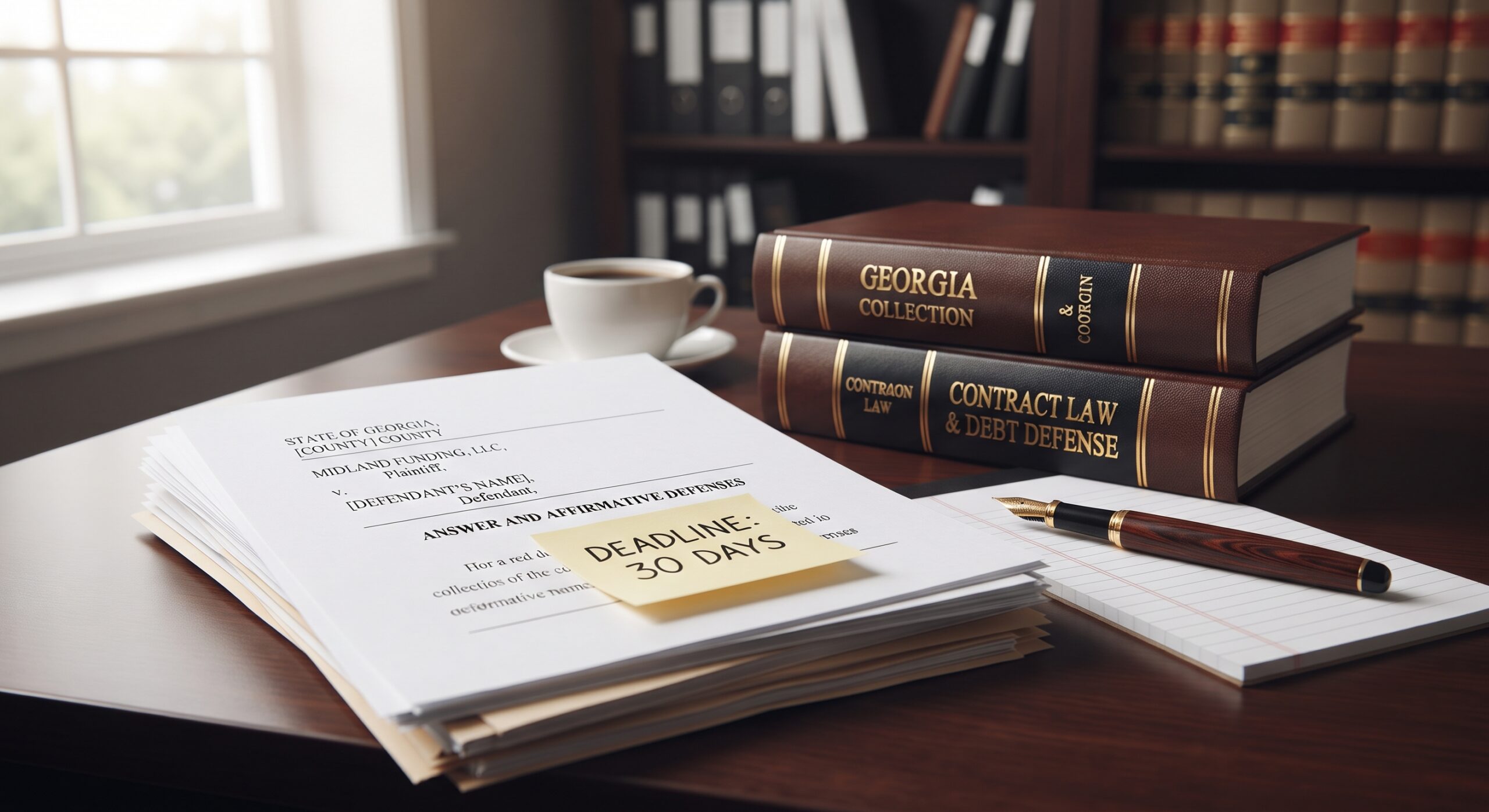
Timing is where people get hurt. You generally have 30 days after service to file an Answer in a Georgia debt collection lawsuit. Skip it and you risk a default judgment, even if strong defenses were available.
What Should You Do If Midland Is Suing You?
Don't assume you have no options just because the summons names Midland Funding, Midland Credit Management, or another debt buyer.
Before admitting the allegations or agreeing to any settlement, it makes sense to have a Georgia debt collection defense attorney look over the complaint and the supporting documents. We approach these cases at Diwan Law, LLC by asking whether the plaintiff can establish its right to collect, whether admissible evidence supports the amount, and whether other defenses apply.
A debt buyer's name on a lawsuit tells you who filed it. It does not tell you who owns the debt, and that gap is where many of these cases are decided.